
Why the World's Longest Flight Has No Economy Class
Somewhere over the far north right now, an Airbus A350 is grinding through the middle of a journey that began in Singapore and won’t finish until it reaches New York, close to nineteen hours after the doors shut. Call home, watch three films, sleep, wake up, eat again, and you’re still hours out. It is currently the longest scheduled passenger flight on Earth: roughly 9,500 miles, no stop, no change of plane.
Here’s the part that catches people off guard. There isn’t a single economy seat on it. Not one cheap ticket to be had. That absence is the whole story in miniature, because the longest flights in the world aren’t a stunt or a flex. They’re a narrow bet on physics and money, and it only pays off under very particular conditions. When those conditions slip, the flights don’t get trimmed. They disappear.
The flights that live on a knife-edge
For most of aviation history, crossing the planet meant stopping in the middle. You flew to a hub, changed planes, and carried on. Dubai, Singapore, Frankfurt, London: those connection points were where the money got made, because whoever controlled the hub controlled the passenger.
An ultra-long-haul flight tears up that arithmetic. When one aircraft covers the entire distance in a single hop, the airline flying it doesn’t have to hand the passenger to anyone in the middle. For the right two cities, both stuffed with people who value a saved day more than a saved dollar, a nonstop is worth a real premium.
But the margins are brutal, and they hinge almost entirely on one number: how much fuel the plane burns to haul itself and its passengers that far. Fuel is the single biggest cost on a flight this long, and on a route pushing 9,000-plus miles there’s very little slack left over. Nudge the oil price up, or fly an aircraft that drinks a little too much, and a route that was quietly profitable turns into a machine for losing money on every departure. That’s why these flights are always the first casualties when fuel gets expensive. They live closest to the line where the math stops working.
The route that died and came back
The best proof that these routes rise and fall on economics is that one of them has already lived, died, and come back to life.
In 2004, Singapore Airlines launched a nonstop between Singapore and Newark. At the time it was the longest flight in the world, and it flew on the Airbus A340-500, a four-engine jet built specifically to reach that far. It worked, for a while. Then oil prices climbed through the late 2000s, and four thirsty engines turned out to be exactly the wrong thing to be carrying across the planet. The fuel bill kept rising and the route kept sinking. By 2013, Singapore did the unsentimental thing: it retired the A340-500 fleet and suspended the flight entirely. The world’s longest route simply switched off.
What the airline never did was give up on the idea. It waited. And in 2018, the aircraft it had been waiting for arrived: the A350-900ULR, the “Ultra Long Range” version of a modern twin-engine jet, efficient enough to fly that impossible distance and still come home with money on board. Singapore restarted the route. The flight that died came back from the dead, roughly a decade later, the moment the technology finally caught up to the ambition.
That gap is the real lesson. The route wasn’t waiting on courage or marketing. It was waiting on a plane efficient enough to make 9,000 miles pay. When the plane existed, the route existed. Before that, no amount of wanting it was enough.
Why there’s no cheap seat on the longest flight
Which brings us back to the missing economy cabin.
At extreme range, weight is the enemy of everything. The farther you intend to fly, the more fuel you have to carry, and fuel is weight, weight that could otherwise have been passengers or cargo. Push a route far enough and the aircraft starts leaving potential payload on the ground just to make room for the fuel to move itself. Every kilogram you load has to be worth the enormous distance it’s about to travel.
So the airline faces a stark choice about what those precious kilograms should be. Cram in 300 economy passengers paying modest fares, and the numbers don’t close: too much weight, too little revenue per pound of it. Fill the plane instead with a smaller number of business and premium economy passengers, each paying a lot, and suddenly the weight you’re carrying is worth carrying.
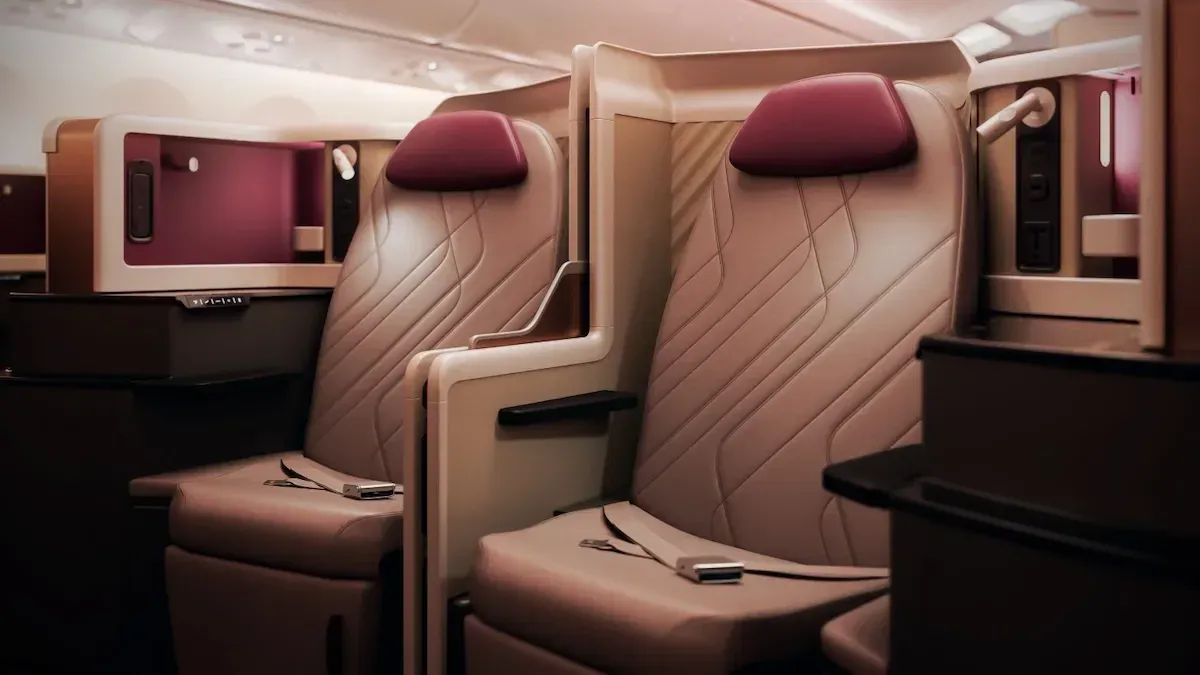
That’s why Singapore’s A350-900ULR on these routes flies with only business and premium economy. No economy cabin at all. It looks like a luxury flex from the outside. Underneath, it’s cold arithmetic: at this range, the only way the math survives is to fill the plane with high-yield passengers and leave the cheap seats behind. The longest flight in the world has no economy class because, at nineteen hours, an economy passenger doesn’t earn their weight in fuel.
The next record, and a name with a history
The record won’t sit still. Qantas has a plan called Project Sunrise: nonstop flights from Sydney to London, and later Sydney to New York, planned to begin around 2027. Sydney to London is a genuinely staggering distance, well over 10,000 miles, and the flight could run up toward 22 hours in the air. If it launches as planned, it would become the longest passenger flight in the world by a clear margin. Curious how any pair of cities measures up? Our flight time calculator works out the great-circle distance and an estimated flying time for any route.
Making it possible takes the same trick as always, pushed further. Qantas is turning to a specially modified A350-1000, fitted with an extra fuel tank and a deliberately reduced cabin, carrying only a couple of hundred passengers rather than the several hundred the airframe could technically hold. Fewer people, more fuel, so the plane can reach the other side of the world without stopping. The same logic that stripped economy off the Singapore flight, taken one step further.
The name is the loveliest part. During the Second World War, after the fall of Singapore severed the usual air routes, Qantas flew Catalina flying boats nonstop between Western Australia and what was then Ceylon, now Sri Lanka. The crossings were so long, up to around 30 hours over open ocean, that the crews and passengers watched the sun come up twice before landing. They called it the Double Sunrise, and passengers who made the crossing earned a certificate marking their place in the Order of the Double Sunrise. Project Sunrise reaches back and picks up that thread, more than eighty years later, on flights so long you’ll once again lose track of what day it is.
The edge of the possible
Look at a map of the longest routes on Earth and you’re looking at a very short list of lines, each one drawn between two cities rich enough and busy enough to justify it, each one flying only because a particular aircraft finally made the distance pay. Take away the efficient engine, or add a few dollars to a barrel of oil, and lines start vanishing from that map.
That fragility is exactly what makes them worth watching. An ultra-long-haul route is the visible edge of what’s physically and economically possible at any given moment: the longest reach technology currently allows, sold at the highest price a handful of travelers will bear. It’s a line on the map that exists only because the machinery caught up to the dream, and that could disappear again the moment the numbers turn. When one of these flights takes off, it isn’t showing off. It’s balancing, right at the edge of what can be done at all.
Read next
What Is the Busiest Airport in the World? (2026)
What is the busiest airport in the world? Atlanta, by a wide margin, moving over 106 million passengers a year. Here's why, and who's closing in.
Routes & NetworksThe Longest Flights in the World 2026, Ranked
The longest flights in the world 2026, ranked by distance, what 18-plus hours onboard feels like, and when Qantas Project Sunrise finally launches.
Routes & NetworksWhy Airlines Fly Empty Planes on Purpose
Why airlines fly empty planes, and how ghost flights protect airport slots that can be worth more than the jet flying them. A rational move, not madness.
Liked this?
Get the next one in your inbox. Aviation explained for the people who never lost the wonder. One email, no noise.