
Why the 747 Has That Hump (It's Not What You Think)
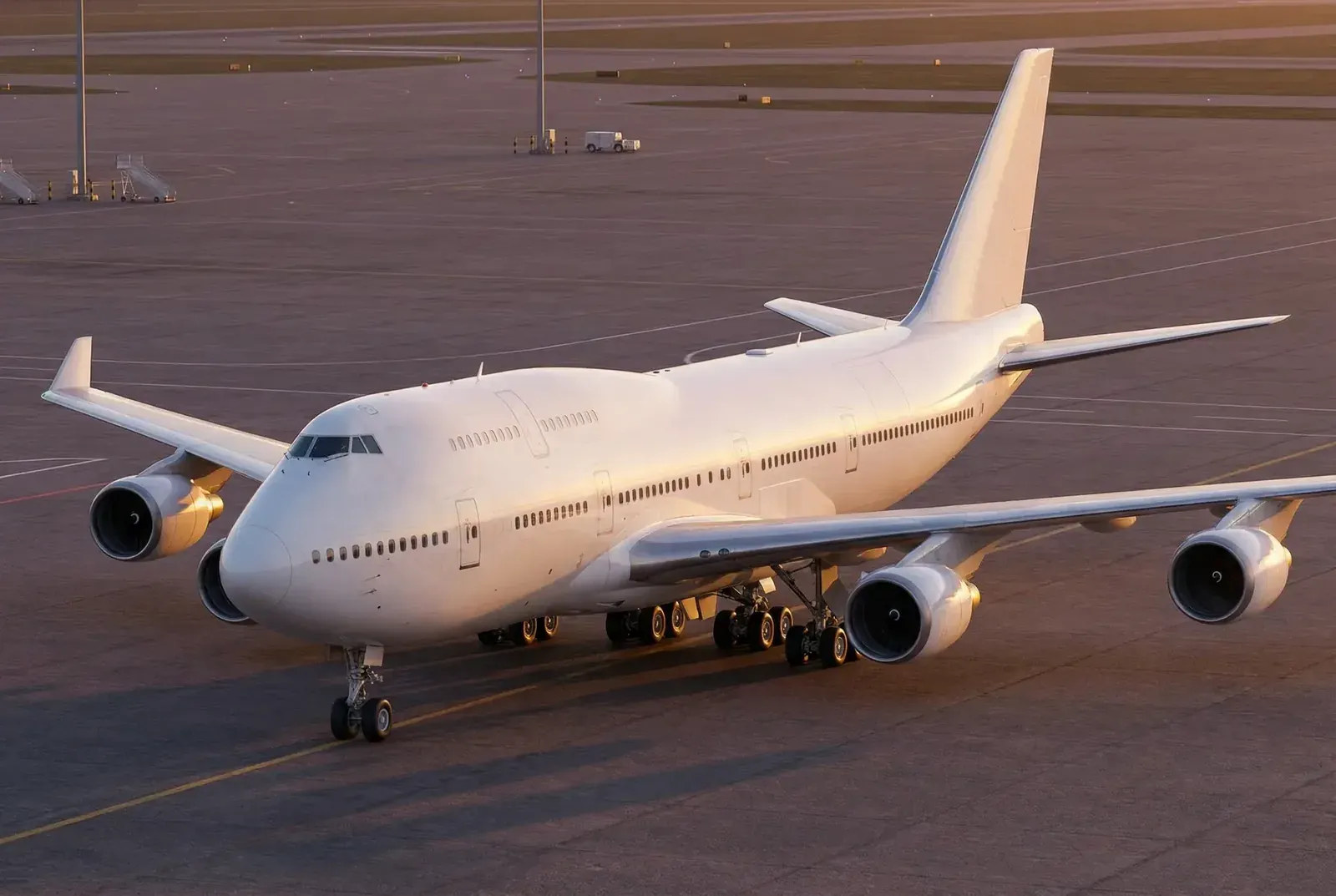
You’ve seen the shape your whole life. The Boeing 747 has a bump on its back, a raised bulge behind the nose that no other airliner has, and it makes the plane instantly recognizable from a mile away or a bad photo. It’s the most famous silhouette in aviation. And almost nobody who points at it in the sky knows it’s there for a reason.
It isn’t a design flourish. It isn’t a lounge that someone decided to build. That hump is an engineering workaround, and the story behind it is stranger than the shape.
The hump is a workaround
Start with the problem Boeing was actually trying to solve: how do you load a truck-sized pallet into an airplane?
The slow way is through a side door, one piece at a time, turning corners inside a narrow fuselage. The fast way is to open the whole front of the plane and drive the cargo straight in. Boeing wanted the fast way. They designed the 747’s nose to swing up and out of the way, like a visor lifting, so freight could go in nose-first in one clean shot.
Here’s the snag. The nose is exactly where the cockpit goes. You cannot put a swing-up door where the pilots sit, and you cannot cut the cockpit in half. So Boeing did the only thing left: they picked up the flight deck and moved it up and back, onto a raised deck behind the nose. That lifted pod, sitting above and behind where the pilots would normally be, is the hump.
The most recognizable airplane in the world looks the way it does because of a cargo door. Everything else about the shape follows from that one decision.
There’s a deeper root, too. A few years earlier the US Air Force ran a competition for a giant new heavy-lifter, and Boeing bid on it with exactly this idea: raised cockpit, hinged nose, drive-through cargo. Boeing lost. The contract went to Lockheed, and that design became the C-5 Galaxy. But Boeing kept the concept in a drawer, and when the 747 came along, they pulled it back out.
Boeing bet on the wrong future
Now the part that turns a fun fact into something better.
Why would Boeing build a passenger jet around a cargo door in the first place? Because in the 1960s, Boeing and much of the industry were convinced that big subsonic planes like the 747 were about to be obsolete for carrying people.
The future everyone saw coming was supersonic. Concorde was on the way. Boeing itself was working on a supersonic transport. The consensus was that within a decade or two, anyone who wanted to cross an ocean quickly would do it faster than sound, and lumbering wide-bodies like the 747 would be left to do the unglamorous work: hauling freight.
So Boeing hedged. If the 747 was going to spend most of its life as a freighter, build it freighter-ready from day one. Design in the nose door. Raise the cockpit to clear it. Make the whole plane wide enough to swallow cargo containers two-across. The hump wasn’t a compromise Boeing regretted. It was insurance against a future they were sure was coming.
Two people drove all this, and it’s worth keeping them straight. Joe Sutter was the engineer who led the 747 team, the man they call the father of the 747, and it was his group that solved the nose-door puzzle. Juan Trippe was the head of Pan Am, the airline visionary who demanded a jet far bigger than anything flying and effectively willed the program into being. Trippe wanted the size. Sutter figured out how to build it.
And the future they hedged against never showed up. Supersonic travel didn’t take over. Concorde stayed a beautiful, tiny, money-losing exception. The masses kept flying subsonic. The 747, built as a just-in-case freighter, became the definitive passenger jet of its age.
The most famous lounge in the sky
Which left Boeing with a curious bit of real estate. The raised deck behind the cockpit, built to clear a cargo door, had space in it. On early 747s it was a small bubble, and airlines had to decide what to do with the room upstairs.
At first they made it a party. Pan Am put a first-class lounge up there, a little upstairs bar reached by a spiral staircase, the kind of thing that sounds invented but genuinely existed. For a few years the fanciest seat in the sky wasn’t a seat at all. It was a couch in a lounge above the wing.
Then the 1973 oil crisis hit, fuel got expensive, and every airline needed more paying passengers per flight. A lounge earns nothing. A row of first-class seats earns a lot. The bars came out and the seats went in, and the upstairs turned from a place to have a drink into some of the most expensive square footage on the airplane. Later versions stretched the hump longer to fit even more of them. The bubble born from a cargo door had become premium cabin space, which is roughly the opposite of what it was drawn for. Only one other jumbo would ever get a full double deck instead of the 747’s partial hump: the Airbus A380, decades later.
The future finally showed up
Here’s where it comes back around.
The 747 spent decades as the Queen of the Skies, the plane that made crossing an ocean something an ordinary family could afford. At roughly two and a half times the size of the 707 that came before it, it flooded the market with seats, and more seats meant cheaper fares. It democratized long-haul flying. For that whole run, the cargo door and the hump were just quirks the passengers never thought about.
And then, slowly, the future Boeing had bet on in the 1960s arrived after all, just aimed at boxes instead of people. As newer twin-engine jets took over passenger routes, the 747 found its second life exactly where Sutter’s team had planned: as a freighter. FedEx, UPS, Cargolux, Atlas, and others still fly 747 freighters today, and that swing-up nose remains a real advantage no other big jet can match. You can load things through the front of a 747 that simply won’t fit any other way.
The plane was built for a freighter future that didn’t come, spent forty years as a passenger legend instead, and then grew up to be one of the great freighters after all. The hedge paid off. It just took decades.
So the next time one goes over, look at the hump. It’s not styling and it was never really a lounge. It’s the fossil of a decision made sixty years ago, a workaround for a door, shaped by a bet on a future that took its time showing up. The most familiar outline in the sky is a small piece of history you’ve been looking at your whole life without knowing.
Read next
Largest Passenger Plane in the World: The Airbus A380
The Airbus A380 is the biggest passenger plane in the world, seating about 525 (up to 853 certified). Here's how it got so big, and why it's still flying.
AircraftWhy Did Concorde Stop Flying?
Why did Concorde stop flying? Not the crash alone. It was the crash, a collapsed travel market, an aging fleet, and a manufacturer walking away, all at once.
The IndustryHow Much Do Airline Pilots Make? The Real Range
How much do airline pilots make? From a regional first officer's rough early years to a senior widebody captain's six-figure climb, here's the honest range.
Liked this?
Get the next one in your inbox. Aviation explained for the people who never lost the wonder. One email, no noise.