
What Causes Turbulence, and Why It Won't Bring a Plane Down
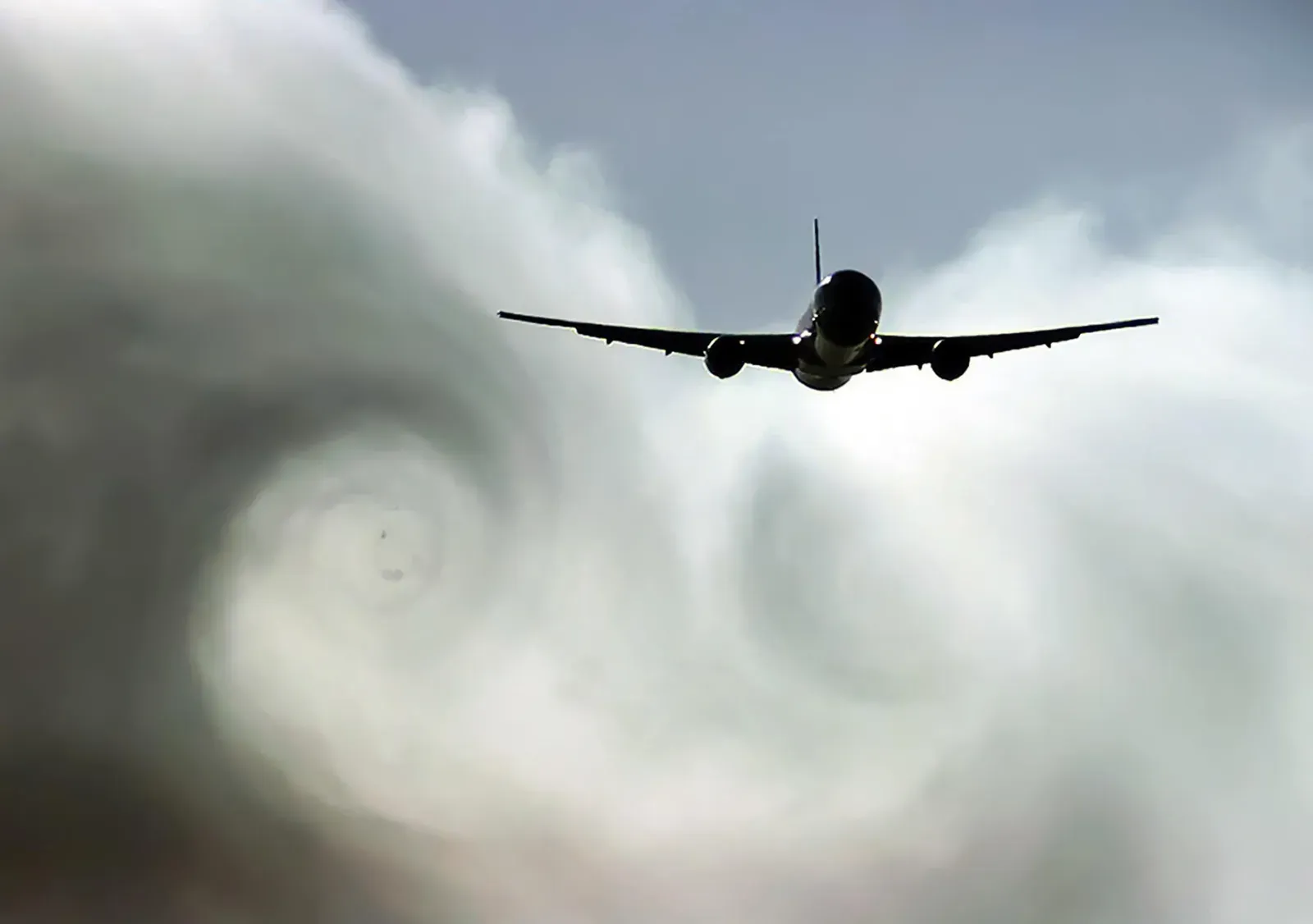
Turbulence is air in motion. Rising heat off the ground, wind tumbling over mountains, thunderstorms, the wake of another jet, and fast rivers of air near the jet stream all stir it up, and a plane flying through that churn gets bounced the way a boat does crossing a wake. It won’t bring a modern airliner down. The person it can hurt is anyone who isn’t buckled in.
You know the moment. The seatbelt sign dings on with no warning, the cabin crew cut the service short and strap in, and the plane starts jumping like a car on a washboard road. Here’s what’s happening outside, and why the plane takes it in stride.
What turbulence actually is
Air isn’t the still, empty backdrop it looks like from your window seat. It moves in currents, layers, and eddies, the same way water does, just invisibly. Turbulence is simply irregular movement in that air: pockets moving at different speeds or directions bumping into each other. A plane flying through it gets jostled the way a boat gets jostled crossing a wake, because it’s riding on a fluid that isn’t behaving smoothly for a moment.
The wings, engines, and fuselage keep doing exactly what they were built to do. Only the air underneath them changed.
The handful of things that stir up the air
Turbulence comes from a short list of ordinary causes, the ones laid out in the FAA’s turbulence guide, and pilots see all of them coming, except one.
Rising warm air. On a sunny afternoon, the ground heats unevenly: a parking lot warms faster than a lake, a plowed field faster than a forest. Warm air rises off the hot patches in invisible columns, called thermals, and cooler air sinks to replace it. Fly through that patchwork at low altitude and you feel every column as a jolt. It’s the same air a hawk rides to climb without flapping, just less pleasant at 250 knots.
Mountains and terrain. Wind doesn’t stop at a ridge line, it flows over and around it, the way a stream breaks into ripples around a rock. That disturbed air, called mechanical turbulence, can extend for miles downwind of mountain ranges, which is why flights near the Rockies or the Alps get a reputation for bumps.
Storms. Thunderstorms are turbulence factories, with violent updrafts and downdrafts inside and rough air for miles around the edges. This is the one cause pilots actively route around rather than fly through, using onboard weather radar to see storm cells well before arrival.
Wake from other planes. Every wing generates a pair of spinning vortices off its tips, invisible funnels of rotating air trailing behind it like a boat’s wake. Fly through one from a jet ahead of you and you’ll feel a jolt. It’s exactly why air traffic control spaces planes out and holds smaller aircraft further back behind heavier ones.
Clear-air turbulence. This is the sneaky one, and the one behind most of the bumps that catch a cabin by surprise. It shows up near the jet stream, the river of fast-moving air many airliners cruise close to, where air masses moving at very different speeds rub against each other. It carries no cloud, no radar signature, nothing a pilot can see out the window or on a screen. Crews rely on forecasts, reports radioed in from other flights ahead, and a fair bit of experience to avoid it, but it can’t always be predicted. And it’s getting more common: a 2023 University of Reading study found severe clear-air turbulence over the North Atlantic rose 55 percent between 1979 and 2020, as warming strengthened the wind shear around the jet stream.
That’s the honest answer to “types of turbulence”: thermal, mechanical, storm-related, wake, and clear-air. Different causes, same effect: a bumpy ride that the aircraft shrugs off every time.
Why the plane handles it so easily
This is the part worth actually knowing, because it’s the part that should calm you down.
Certification rules require an airliner’s structure to carry 1.5 times the biggest load it should ever meet in service, and turbulence sits inside that service envelope. Manufacturers prove it on a test rig. In 1995 Boeing bent a 777 wing upward until it finally broke, at 154 percent of the maximum load it was designed to see in service. That wingtip you see bobbing outside the window is a wing built to bend, soaking up each jolt the way a fishing rod soaks up a tug on the line.
Everyday turbulence, even the rough kind, puts only a fraction of that load on the airframe. Modern airliners don’t get knocked out of the sky by it. They ride through it, sometimes uncomfortably, and land on schedule.
The sky does this. The plane just rides it out
So is turbulence dangerous? To the aircraft, essentially never. To you, only if you’re standing up or unbuckled when it hits. FAA figures show that from 2009 to 2021, nearly 80 percent of serious turbulence injuries on US airlines were to crew, who are on their feet working the cabin. The passengers who get hurt are mostly the ones who weren’t buckled in, often because the sign had been off for a while. That’s the same everyday habit that matters more than seat selection ever will: keep the belt fastened whenever you’re in your seat, sign on or off. It’s the sky moving under you, and the aircraft was built to ride through exactly that.
FAQ
What causes turbulence on a plane? Irregular movement in the air: rising warm air on hot days, wind disturbed by mountains and terrain, storms, wake vortices trailing off other aircraft, and clear-air turbulence near the jet stream, which is invisible and the hardest kind to forecast.
Is turbulence dangerous? Not to the aircraft. Airliners are built with structural margins far beyond anything turbulence produces. The real risk is injury to anyone not strapped in, which is exactly why the seatbelt sign exists.
Can turbulence flip or crash a plane? No. Turbulence essentially never brings down a modern airliner. Planes are designed and certified to fly straight through it, and pilots additionally route around the roughest patches, like thunderstorms, whenever they can see them coming.
Why do wings flex so much in turbulence? On purpose. Wings are engineered to bend and absorb loads rather than stay rigid, which is what makes them strong. Watching a wingtip flap gently is watching the design work exactly as intended.
Is clear-air turbulence getting worse? Yes, by the best measurements so far. A 2023 University of Reading study found severe clear-air turbulence over the North Atlantic rose 55 percent between 1979 and 2020, linked to stronger wind shear around the jet stream as the climate warms.
Where is the smoothest seat in turbulence? Over the wings. That’s close to the plane’s center of gravity, so you move the least when it pitches. The back rows swing the most.
Read next
The Safest Seat on a Plane, According to the Data
The safest seat on a plane, according to decades of crash data, and the honest reason it matters far less than you'd think.
Incidents & SafetyWhy Is the Black Box Orange? What Flight Recorders Really Do
The black box is bright orange so searchers can find it, and it's really two recorders. What each one captures, and the man who invented it.
Incidents & SafetyWhat Is Clear-Air Turbulence? The Bumps Nobody Can See
Clear-air turbulence hits in cloudless sky near the jet stream, with nothing on radar. What causes it, how pilots dodge it, and why it's getting worse.
Liked this?
Get the next one in your inbox. Aviation explained for the people who never lost the wonder. One email, no noise.